AI Shouldn't Replace Teachers. It Should Help Them Understand Students Better
For almost thirty years, I've walked into classrooms as a mathematics teacher.
During that time I've taught thousands of students, and one lesson has become clearer every year: the answer written on the page is only a small part of what is really happening.
The real challenge has always been understanding how a student is thinking.
What assumptions are they making?
Where did their reasoning change direction?
What misconception is preventing the breakthrough?
These questions matter far more than simply knowing whether an answer is right or wrong.
That belief has shaped not only my teaching, but also my academic research.
Over the last few years I've been exploring a question that sits at the heart of my Master's research at the University of Haifa:
Can artificial intelligence help teachers understand student thinking—not simply assess whether an answer is correct?
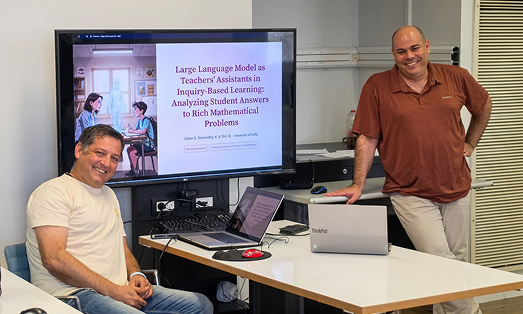
This week I had the privilege of presenting that research, together with Dr. Shay Olsher, as part of a course on computer-based assessment in mathematics. I was honoured that the Greenhouse Center also chose to share our work.
While the research involves large language models and artificial intelligence, the technology itself is not what excites me most.
AI will continue to evolve. Today's models will become tomorrow's history. New tools will emerge, capabilities will improve, and education will continue to adapt.
The more important question is one that will remain long after today's technology has changed:
How can we help teachers better understand the thinking behind a student's work—especially when solving open-ended mathematical problems that have more than one valid approach?
This is where I believe artificial intelligence has the greatest potential.
Not to replace teachers.
Not to automate relationships.
But to provide deeper insight into how students think, where they struggle, and how personalised guidance can help them reach their own Aha Moment.
The future of AI in education should not be measured by how many teachers it replaces.
It should be measured by how much more effective, informed and impactful teachers become because of it.
That is the future I hope to contribute to.
This research is only the beginning of a much longer journey—one of learning, questioning, experimenting, making mistakes, improving, and hopefully contributing, even in a small way, to the future of mathematics education.
My sincere thanks to Dr. Shay Olsher, Prof. Michal Yerushalmi, and the Greenhouse Center for their guidance, encouragement and trust throughout this journey.
I'd love to hear your thoughts.
How do you think AI should support teachers without replacing the human side of education?